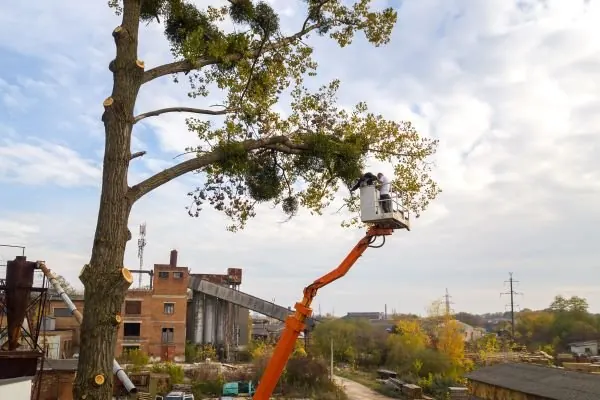
Why the Armadale hills are different
Drive east from Armadale's town centre or up from Kelmscott and within minutes you are on the Darling Scarp: steeper streets, bigger blocks, and houses tucked among jarrah, marri and wandoo with bush running right up to the back fence. Much of it is beautiful country to live in, and much of it is mapped as bushfire prone.
Living there means taking responsibility for the vegetation around your house. Firefighters cannot defend every home on a bad day, and the state's guidance is clear that what you do with the trees and undergrowth close to the building makes a real difference to whether it survives. This guide explains the rules that apply to clearing and pruning trees on those blocks, in plain terms, with links to the documents themselves.
It is general information, not fire-safety or legal advice. The documents change, and the City of Armadale and the Department of Fire and Emergency Services (DFES) are the bodies to confirm anything with.
Step one: is your block bushfire prone?
Everything starts with the state Map of Bush Fire Prone Areas. You can search your address on the mapping viewer linked from the DFES website. If any part of your lot is shaded as bushfire prone, the rules below may apply.
It is not only the obvious hills properties. Lots on the plain that border reserves, creek lines or wetlands can be mapped too. Look it up rather than assuming.
Step two: the Bush Fire Risk Treatment Standards
In Western Australia, the Bush Fire Risk Treatment Standards allow owners and occupiers of land in bushfire prone areas to carry out specified vegetation management around certain buildings. DFES describes the benefit simply: if the standards are followed, people will not be liable to prosecution under other laws for that clearing. In other words, they give homeowners a defined, legal way to reduce the fuel close to the house.
The standards do not apply everywhere, and they only cover specific activities. Three questions decide whether you can use them.
1. Is the land designated bushfire prone?
That is the map in step one.
2. Does an exclusion apply?
DFES lists exclusions where removing or modifying vegetation could conflict with significant environmental or heritage values, and the standards do not apply in those places. According to the DFES guide, they include land under certain conservation covenants, Aboriginal heritage sites, Bush Forever areas and land with confirmed threatened ecological communities or threatened flora, among others. Check the exclusions list in the guide before you clear anything.
3. Is the vegetation within a Risk Treatment Area?
The guide defines a Risk Treatment Area as land within 20 metres of a relevant building. A relevant building includes a house, duplex, villa or townhouse, along with some other building classes, and sheds, carports and garages within six metres of a house.
There is a catch that matters in the newer parts of the corridor. The DFES guide says the standards apply to buildings constructed under development approval obtained before 8 December 2015. Developments approved after that date were required to build in separation from bushfire prone vegetation through their siting and design, so the standards do not cover them. If your house is newer, speak to the City about what applies.
Step three: the inner and outer zones
Within the 20 metre Risk Treatment Area, the guide describes two zones. This is where tree work gets specific.
Inner zone: 0 to 10 metres from the building
The inner zone creates defendable space between the building and flammable vegetation. According to the DFES guide:
- removing underlying vegetation and trees is permitted
- a tree that sits across a boundary can be removed only with the neighbouring owner's consent
- branches overhanging the inner zone from the outer zone or from a neighbouring property can be pruned back to the branch collar on your land (or with the owner's consent), or back to the boundary
Outer zone: 10 to 20 metres from the building
The outer zone is managed to slow a fire's spread and stop it climbing into the tree canopy. Here the guide says:
- vegetation can be removed or modified, but not trees
- branches lower than two metres above the ground can be pruned back to the collar (on your land or with consent) or to the boundary
What counts as a tree
The guide defines a tree as a woody perennial with one or more self-supporting trunks standing at least five metres tall. Shrubs and smaller plants are vegetation. Trees on a Significant Tree Register are not covered by the standards at all.
If the property is strata titled, rented or leased, the guide says to get consent from the strata company or property manager before removing or modifying vegetation.
Asset Protection Zones
DFES also talks about an Asset Protection Zone, or APZ: a low-fuel area immediately surrounding a building. DFES says it should include a defendable space next to the building, no less than three metres wide, with minimal vegetation and nothing combustible stored in it. A well-maintained APZ gives the house a better chance of being defended during a fire, and of surviving if it is left undefended.
For trees, that usually means:
- No branches over the roof. Overhanging limbs drop leaves and bark into gutters and give flames a path to the house.
- Lifted crowns. Removing lower branches so the canopy is well clear of the shrubs and grass below breaks the ladder that lets a ground fire climb into the trees.
- Gaps between crowns. The DFES guide suggests nearby tree crowns be separated so they do not form a continuous canopy.
- Clean ground. Bark, leaf litter and dead branches under trees are fuel. Rake them up before summer.
How to prune without harming the tree
The aim is to reduce fuel, not to destroy the tree. The DFES guide recommends cutting branches just beyond the branch collar rather than flush with the trunk, undercutting heavy branches first so they do not tear, keeping a balanced shape, and refers to the Australian Standard for pruning amenity trees (AS 4373). It describes three methods:
- Crown lifting: removing the lowest branches up to about two metres above the ground.
- Crown thinning: removing smaller branches while keeping the main structure.
- Selective pruning: removing the branches that create the greatest hazard, such as those over the roof or joining two canopies.
Topping a large gum to a stump is not one of them. It produces a mass of weak regrowth that is more of a fire and safety problem a few years later.
Slopes, soil and erosion
Hills blocks bring another responsibility. The DFES guide reminds owners that they remain legally responsible for soil erosion and landslip caused by clearing, under the Soil and Land Conservation Act 1945. It recommends disturbing the soil as little as possible, not removing vegetation from below the surface, keeping ground cover, avoiding heavy soil-breaking machinery, and not clearing on slopes steeper than 18 degrees without a geotechnical engineer's advice.
That has a practical effect on stumps. On a steep hills block, grinding a stump is often better than digging it out, because it leaves the root mass holding the soil. See stump grinding for how that works.
Black cockatoos and old hollows
Large old marri and jarrah in the Armadale hills can carry hollows used by black cockatoos, which are protected species. If a big old tree with hollows is on your list, talk to the City and get advice before it comes down. Pruning a limb over the roof is very different from removing a habitat tree.
Firebreak notices are separate
Every year, WA local governments issue their own fire hazard and firebreak requirements for their district, with dates by which work must be done. The City of Armadale publishes its own. Those requirements sit alongside the risk treatment standards; meeting one does not automatically mean you meet the other. Check the City's current notice each season.
Power lines
If any tree you want to prune or remove is near a power line, stop and plan. Trees near the service line to your house can often be worked on by a contractor with the right precautions; trees near the street mains are Western Power's territory. Never attempt to cut a branch that is touching a line.
Putting it together
A sensible order of work for a hills house before summer:
- Check the map and the exclusions.
- Measure out 10 and 20 metres from the house and sheds.
- Note which trees are in the inner zone, which are in the outer zone, and which have hollows or sit on a slope.
- Check the City's firebreak notice for the year.
- Get a quote that lists each tree and what is to be done to it: removed, crown lifted, thinned or left alone.
Tree Solutions WA can arrange a local contractor to look at the block and put that in writing. Call (08) 7666 1429, or see the tree removal page and the Kelmscott area notes for more on hills tree work.