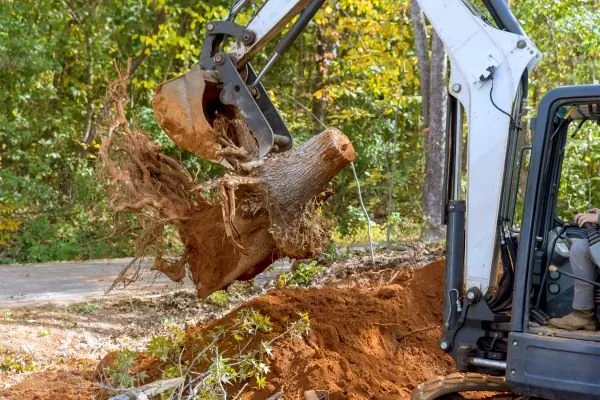
What stump removal means
When a tree comes down, the stump is normally left cut close to the ground. You then have two choices. Stump grinding chips the stump away to below the surface. Stump removal, covered on this page, digs the stump and its main roots out of the ground altogether.
Removal is a bigger job. It normally needs a small excavator or a tracked loader with a stump-pulling attachment, and it leaves a hole that has to be filled. In exchange, the ground is cleared of the woody mass that would otherwise rot and settle over the next few years. If anything structural is going over the spot, that matters.
Why builders ask for it
If you are building in Armadale, Harrisdale, Piara Waters or anywhere else in the corridor, your builder or engineer may specify that stumps and roots are removed from the building footprint. Rotting roots leave voids that can cause slabs and paving to settle unevenly. For a lawn or a garden bed, grinding is usually enough. For a slab, a pool shell, a retaining wall footing or a long run of pavers, removal is the safer choice.
Ask your builder exactly what they need. Sometimes they want only the stump out to a set depth; sometimes they want every root above a certain thickness removed within a set distance of the footing. Give the contractor that specification so the quote matches it.
Soil makes a difference here
The south-east of Perth has very different ground from one suburb to the next, and it changes how stumps come out.
Sandy plain, around Canning Vale, Southern River, Harrisdale and Piara Waters, is the easiest. Roots spread wide but shallow, and the sand falls away from them as the stump lifts. The hole tends to slump, so it is usually backfilled straight away.
Clay, around Byford and parts of the lower Armadale plain, grips roots hard in summer and turns heavy and sticky in winter. A stump that would lift easily from sand can take far longer here, and the spoil is harder to handle.
Gravelly hills ground, around Kelmscott and the scarp side of Armadale, often has rock not far below the surface. Roots wrap around stones and follow cracks. Some stumps on these blocks are better ground down than dug out, simply because the excavation would disturb the slope.
Services underground
Older trees often have pipes and cables running right past them, because the tree was there first and the trench went around it. Before any digging, lodge a free Before You Dig Australia enquiry for your address. It tells you which utility networks are mapped near the property.
Private services are not on that map. Think about reticulation lines and controllers, power run to a shed or pool pump, a septic tank or leach drain on an older or semi-rural lot, and stormwater soakwells. Mark anything you know about with a stake or spray paint and tell the contractor.
What happens to the stump
Pulled stumps carry a lot of soil and stone with them, which makes them heavy and awkward to dispose of. Some contractors split and load them for green waste disposal; others will leave them on site for you to deal with. It needs to be on the quote, because it can make a real difference to the price.
Before and after
On the day, clear the area of anything movable: pots, outdoor furniture, the trampoline. Tell the crew where the reticulation runs. Afterwards, check the hole has been filled as agreed and that the access route has been tidied. If you are building, let your builder know the depth and extent of the excavation.
Prices for removal sit above grinding for the same stump. The cost guide has 2026 bands for both, and the stump grinding page explains the lighter option.