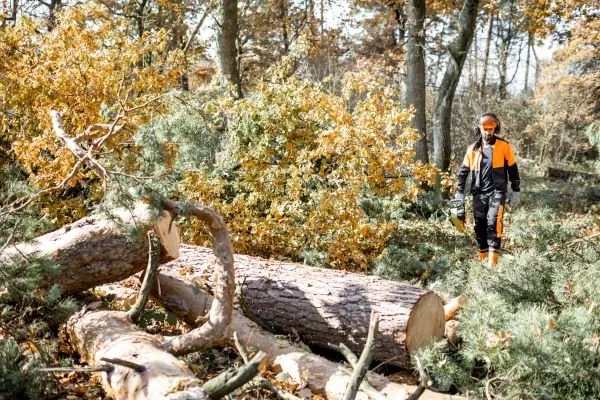
What tree removal in Armadale involves
Tree removal means taking the whole tree down and clearing it away. In a paddock that can be a single cut. In a suburban backyard in Armadale, Kelmscott or Harrisdale it almost never is. Houses sit close together, fences run right up to the trunk, and there is often a power line to the house running through or near the canopy.
So most removals here are sectional. A climber goes up the tree, ties off each limb, cuts it and lowers it on a rope to the ground crew. The trunk is then taken down in short lengths from the top. Where there is truck access, an elevated work platform or a crane can sometimes do the same job faster, especially for trees leaning over a roof.
Once the tree is on the ground, branches go through a chipper, logs are cut to lengths that can be carried, and the area is raked and blown down.
Hills trees and plain trees are different jobs
On the scarp side of Armadale and around Kelmscott, the trees that cause problems are usually big native hardwoods: marri, jarrah and flooded gum, sometimes a century old. The timber is dense and heavy, blocks slope, and the tree may be above the house. Lowering the wood safely and getting it up to the road is often more work than cutting it. Marri is also prone to a canker disease that can weaken the trunk, so an old marri with oozing wounds is worth having assessed.
On the plain, from Harrisdale and Piara Waters across to Canning Vale and Southern River, the soil is sand and the water table rises close to the surface in winter. Trees here have shallow, wide root plates. That means a tree can stand happily for years, then go over in one strong front when the ground is saturated. A tree that has begun to lean after a wet week deserves a call.
In older suburbs like Gosnells, Thornlie and Maddington, the issue is more often size: Cape lilacs, Queensland box, liquidambars and lemon-scented gums planted decades ago that have grown well past the block.
When removal is the right answer
Not every problem tree has to go. A good contractor will tell you when pruning, a crown reduction or removing one dead limb would solve it. Removal is usually the better call when:
- the tree is dead or dying, and the canopy will not recover
- there is a structural defect in the trunk or main fork
- the tree has become unstable at the root plate
- roots are damaging a structure, pipe or slab and cannot be cut without destabilising the tree
- the tree is in the way of building work you have approval for
If you are not sure, ask for both options on the quote: what it would cost to remove the tree, and what it would cost to make it safe and keep it.
Approvals and verge trees
Before you book, check who the tree belongs to and whether anything protects it.
- Verge trees are council property. The City of Armadale, City of Gosnells and Shire of Serpentine Jarrahdale each manage their own street trees, and residents should not remove or heavily prune them.
- Planning conditions on newer estates and recent developments can require trees to be kept.
- Native vegetation on larger lots can fall under the state clearing rules administered by the Department of Water and Environmental Regulation, unless an exemption applies.
- Bushfire prone land has its own rules about what can be cleared around a house. Our bushfire guide explains them.
When in doubt, ring the council before work starts. It costs nothing and avoids a fine.
Power lines
If any part of the tree is close to a power line, say so when you ask for a quote. Work near the line running from the street to your house is often possible with the right precautions. Work near the street mains is a different matter and may need Western Power involved. If a tree or branch is already touching a line, keep everyone well away and call Western Power first.
What it costs
Removal prices depend on height, access, what the tree could hit, and whether the stump and wood leave the property. The 2026 cost guide sets out planning bands. The only accurate figure comes from someone standing in your yard, and quotes are free.